ELITE AU PAIR ACADEMYThe Elite Skills That Determine Whether a Placement Settles.

A structured three-week curriculum that builds the communication and childcare skills au pairs need to perform confidently and reliably inside their host family home.
An au pair who interviews well is not the same as an au pair who performs well. The gap between the two isn't motivation or character, it's skill. The Elite Au Pair Academy closes that gap with skills that are practical, situational, and grounded in the frameworks that actually work inside a household.
The first EAP Academy cohort commences June 5th
·
The first EAP Academy cohort commences June 5th ·
The Skill Gap Is Where Rematches Begin.
WHY IT MATTERS
Your au pair arrived having completed 32 hours of pre-departure orientation and safety certification. She interviewed well and was motivated. And then she was inside a real home, with a real toddler having a real meltdown, and she had no framework for what to do next — only good intentions.
That gap between orientation and execution is where most early rematches begin. Because she was never trained for the specific situations that determine whether a placement holds.
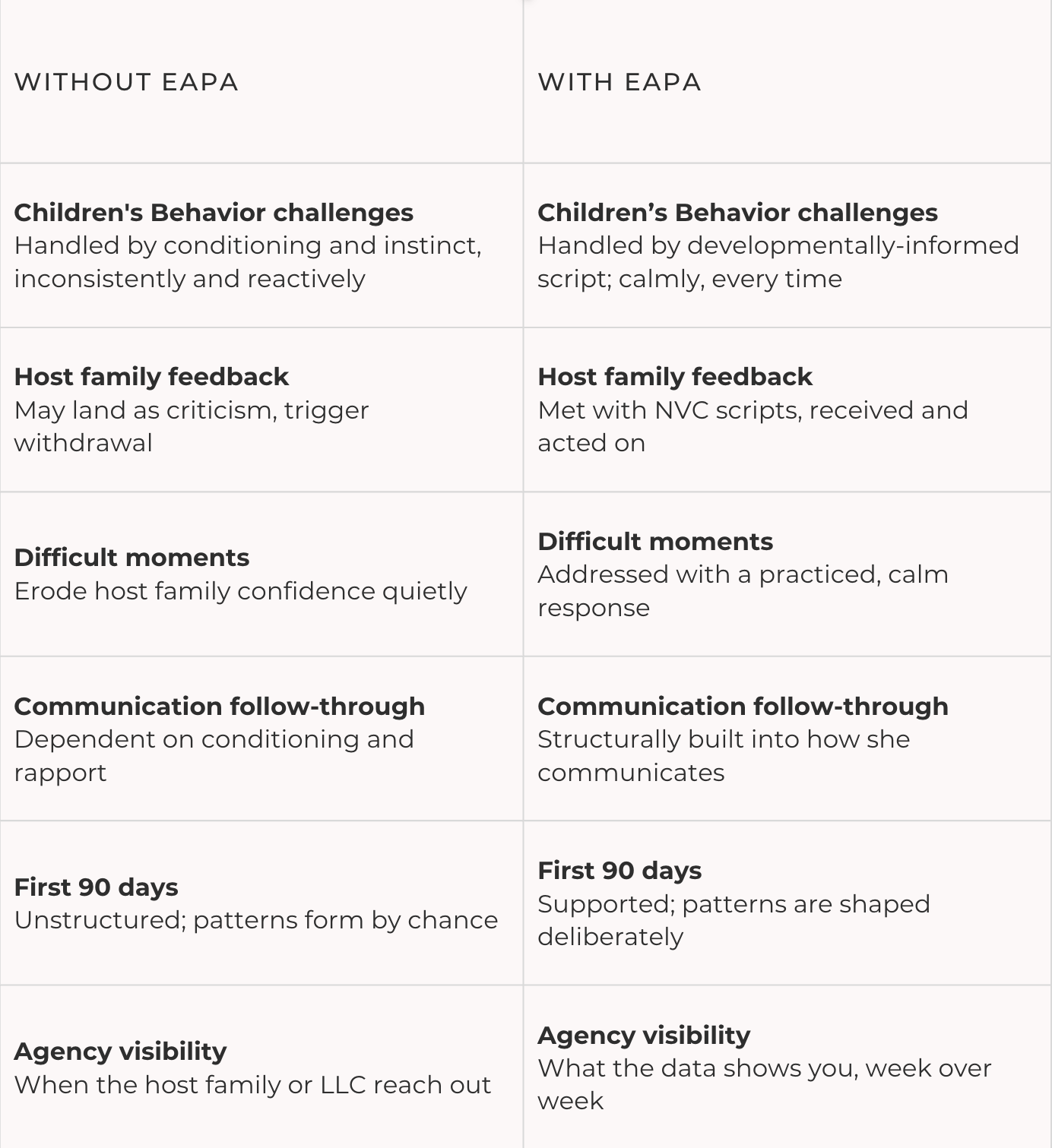
The Elite Au Pair Academy was built to close that gap, with situational scripts for the exact moments that erode host family confidence, a communication framework grounded in NVC applied specifically to the au pair's role, and the emotional foundation that determines whether she can show up consistently when the work gets hard.
STANDARD J-1 TRAINING
Prepares au pairs for the program.
32 hours. Pre-departure. Group orientation. Safety protocols, regulations, general child development theory.
ELITE AU PAIR ACADEMY
Prepares au pairs for
the home.
3 weeks. During placement. Situational scripts, NVC, Positive Discipline, emotional regulation. Built around the exact gaps that cause early rematches.
What your au pair currently has, and what EAPA adds.

"Standard training prepares au pairs for the program. The Elite Au Pair Academy prepares them for the home."
The 32-hour requirement hasn't changed since 1995. The gaps it leaves haven't either.
EAPA was built to fill them.
In three weeks, au pairs learn practical responses to the exact situations that destabilize new placements.
The Academy
MODULE 1
Childcare Execution
Positive Discipline in Practice
MODULE 2
Communication
Nonviolent Communication for the Au Pair Role
MODULE 3
Self-Awareness and Role Clarity
The Inner Foundation

Module 1: Positive Discipline in Practice
The first module builds the foundational childcare skills that determine whether a host family feels they can genuinely step away — and trust that their au pair can handle what arises.
Au pairs begin with the principles behind Positive Discipline: why kind, firm, and consistent responses produce more stable behavior than reactive ones, and why this matters specifically for an au pair navigating a household she is new to. They then apply those principles across 45 situational examples drawn directly from the challenges most common in new placements — tantrums, resistance at transitions, sibling conflict, defiance, testing behavior, and the kinds of difficult moments that, when handled poorly, quietly erode host family confidence and au pair morale.
Each situation includes a specific, usable script, ESL-friendly language to reach for in the moment.
By the end of Module 1, au pairs have working responses to the scenarios most likely to appear in their first weeks in the home.

Module 2: NVC for the Au Pair Role
The second module addresses the communication dynamic that determines whether requests lead to follow-through and whether conversations between the au pair and host family feel productive.
Au pairs are introduced to the principles of Nonviolent Communication: how to express needs clearly, receive feedback without defensiveness, and respond to requests in ways that build rather than erode trust. They then work through four lessons of situational examples specific to the au pair context: receiving criticism about childcare, navigating unclear expectations, addressing their own needs with the host family, and maintaining constructive communication when tension is present.
The goal is not simply harmonious feelings. It is observable follow-through, promoting the kind of reliability that host families notice, and that stabilizes placements.

Module 3: Self-Awareness and Role Clarity
The third module supports the internal conditions that allow au pairs to show up with patience, presence, and steadiness across the entire arc of a demanding placement. This includes guided self-reflection writing exercises, dyadic work, and audio meditations developed for the specific emotional landscape of living and working inside someone else's home.
This reduces emotional reactivity and improves consistency in how the au pair shows up day to day, imparting a sense of personal pride in the intimate work they do.


What the Academy Contains
Three-week structured program — one module per week, released sequentially to allow for absorption and real-world application between lessons.
Format: Video instruction · Applied practice homework · Journaling · Three quizzes · Guided audio meditations · Hosted on Kajabi
Curriculum: 45 Positive Discipline situational scripts · NVC frameworks and scripts adapted for the au pair role
Time commitment: Approximately 3 to 4 hours per week
Certificate of completion awarded upon earning a minimum score of 90% — ensuring the credential reflects demonstrated mastery, not just certification. Au pairs who do not meet the threshold repeat the relevant assessment until they do.
What Agencies See After Au Pair Certification with the Academy

When an au pair completes the Elite Au Pair Academy, the change is observable — not in attitude, but in behavior. Children are handled with more consistency and calm. Difficult moments are responded to rather than escalated. Requests are followed through on. Conversations feel more direct and less avoided
These are the conditions under which a placement settles. They are also the conditions that spare your coordinators from managing the fallout when they don't.